DePin - December 4, 2025
DePIN Deepdive - Is The New Industrial Stack Onchain?
Discover how DePIN is powering the new industrial stack, from robotics to satellites, using crypto to coordinate real-world infrastructure at scale.
Back to Insights
Is The New Industrial Stack Onchain?
DePIN is no longer a side narrative. It's becoming crypto’s foundation for building, powering, and connecting the real world.
[[divider]]
Where Crypto Meets the Physical World
Crypto is entering its most physical phase yet.
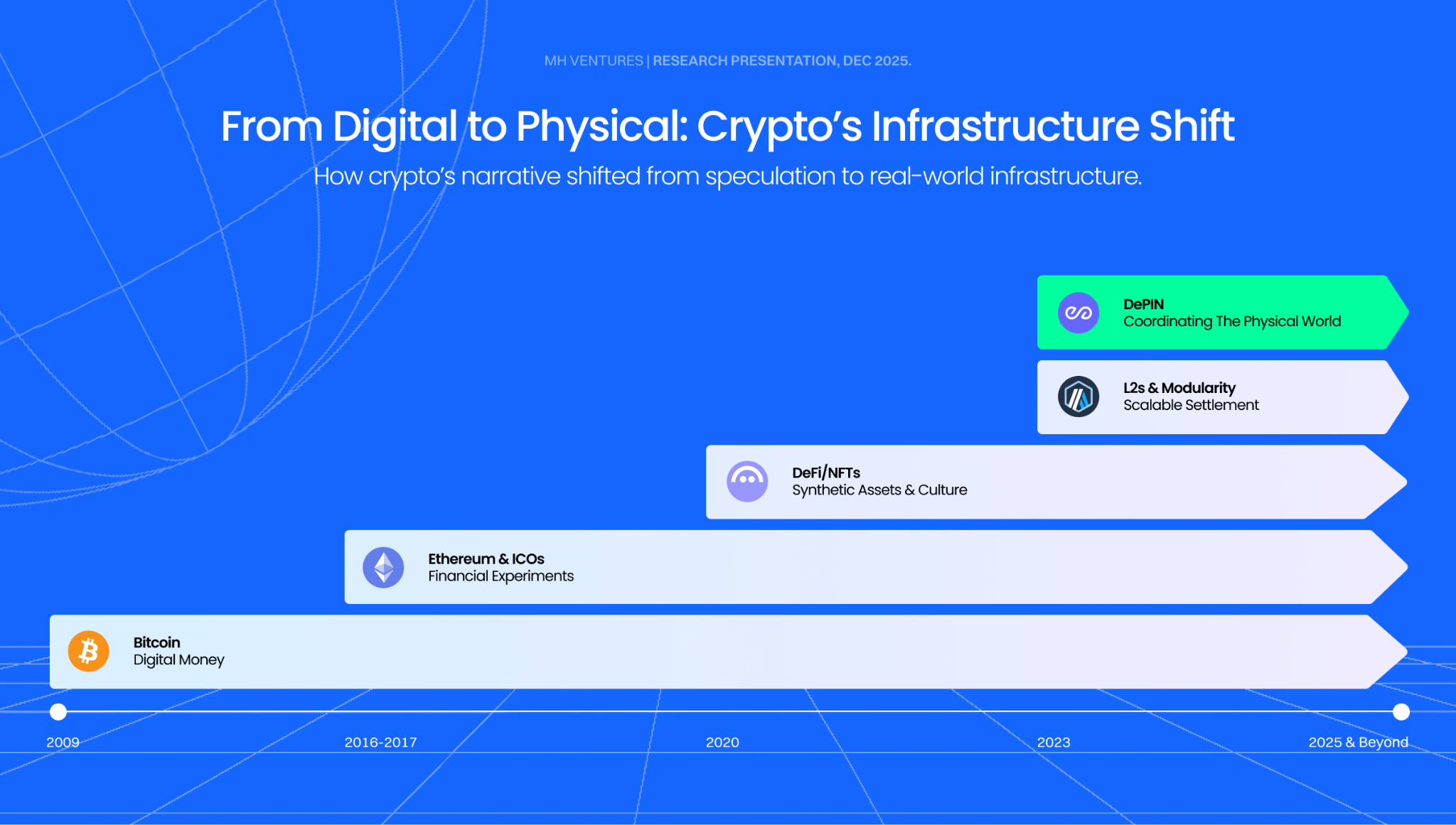
The early cycles were about native money, synthetic assets, and digital collectibles. But the next frontier isn’t digital at all, it’s industrial. From autonomous robotics and AI to satellites and power infrastructure, blockchains are beginning to coordinate the real-world networks that underpin modern life.
This new phase is sometimes called DePIN; decentralized physical infrastructure networks, but what’s actually happening is deeper: a new industrial stack is forming, coordinated not by governments or mega-corps, but by distributed contributors and tokenized incentives.
The world needs this. AI is straining power grids. Supply chains are fragmented. Data monopolies are slowing innovation. And behind the scenes, crypto networks are quietly stitching together new systems to solve these problems.
We’re watching a shift from speculation to coordination. And we think it's just getting started.
[[divider]]
What Is DePIN, Really?
What Is DePIN, Really? Let’s break it down, no buzzwords, no hype.
DePIN stands for Decentralized Physical Infrastructure Networks. But forget the acronym for a second.
Here’s what it actually means:
Imagine if Uber, AWS, or Weather.com didn’t rely on giant companies with giant servers, but instead worked because thousands of people and devices around the world chipped in, got rewarded, and kept the whole system running.
That’s DePIN in its simplest form:
Real-world infrastructure, powered by everyday contributors, coordinated by crypto.
These contributors could be:
- 🔵 People running a sensor on their balcony to collect weather data (like Nubila)
- 🔵 Robots performing jobs in warehouses (like XMAQUINA)
- 🔵 Satellites beaming down location signals (like GEODNET)
- 🔵 Smart cars earning money for sharing data or completing tasks (like on peaq)
What connects all of them is that they’re not controlled by a central company. Instead, they’re plugged into crypto networks where tokens incentivize behavior, verify contribution, and settle payments, all automatically.
So instead of renting weather data from a monopoly, you get it from thousands of contributors who are each rewarded for helping.
That’s why people call DePIN “Uber without Uber” or “AWS without Amazon.” But in reality, it’s even more ambitious than that, it’s the emergence of a modular industrial stack, where each layer (machines, networks, sensors, data) is decentralized by design.
In short:
- 🔵 Infrastructure = real-world systems that make things work (data, compute, logistics, sensors)
- 🔵 Decentralized = no one company controls it
- 🔵 Crypto = the mechanism that coordinates, incentivizes, and pays the people or machines doing the work
And it’s already happening, quietly, but fast.
[[divider]]
Why Now? The Conditions Have Changed
The timing here isn’t a coincidence. A few macro tailwinds are colliding:
- 🔵 AI’s energy hunger is reaching critical levels, with major compute centers throttled by power constraints, especially outside the US
- 🔵 Decentralized compute is gaining traction as a hedge against hyperscaler lock-in
- 🔵 Real-world oracles are essential for everything from autonomous vehicles to insurance pricing
- 🔵 Geopolitical fractures are breaking traditional infra monopolies, creating an opening for crypto-native alternatives
As a16z recently put it, “the cost to coordinate at scale has fallen.” DePINs leverage that, replacing rent-seeking middlemen with permissionless coordination powered by tokens.
That’s why projects like Helium, Akash, and Hivemapper gained early traction. But the next wave is smarter, leaner, and more focused on real demand.
Why DePIN Matters, a16z
Blockworks: Lower Barrier than Stablecoins
Messari’s DePIN Landscape Report
[[divider]]
Spotlight: The Emerging Stack
A full DePIN ecosystem isn’t built by one player. It’s layered.
Below is a snapshot of the modular stack we see forming, powered by four emerging leaders from our portfolio:
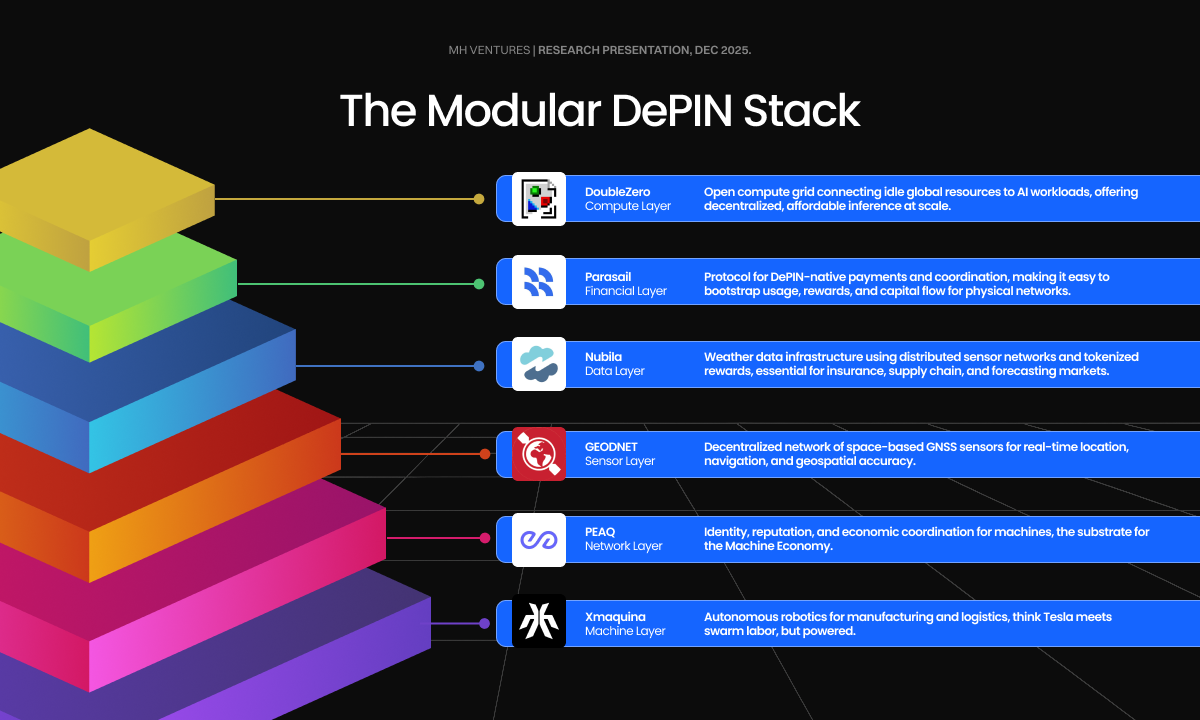
Each of these is live. Each solves a unique layer of the stack. And each uses crypto not as a buzzword, but as a coordination tool to unlock real-world participation.
[[divider]]
What Success Looks Like
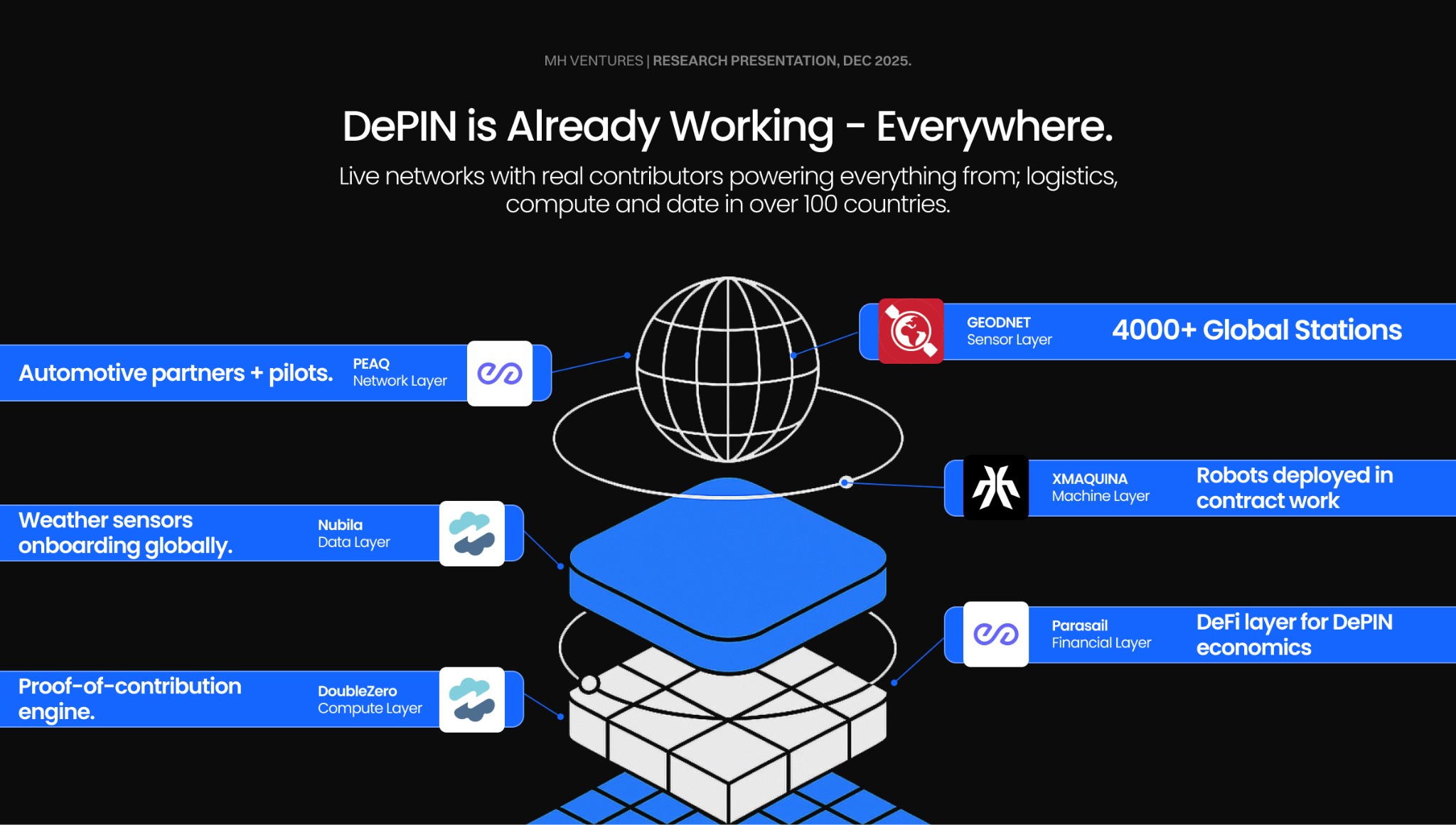
A credible DePIN project isn’t just running onchain, it’s creating a real market with real contributors.
- ✅ GEODNET has over 4,000 live stations across 100+ countries, generating geospatial data used in logistics and autonomous systems.
- ✅ Peaq is partnering with major automakers to provide identity and revenue rails for autonomous vehicles.
- ✅ XMAQUINA is deploying real robots for contract work, each tracked and paid per job via smart contracts.
- ✅ Nubila is onboarding weather stations globally and building oracle infrastructure for dapps.
- ✅ DoubleZero is already powering AI inference workloads on a distributed compute network, reducing latency and cost by leveraging unused GPU capacity globally.
- ✅ Parasail has become the go-to rewards engine for DePIN teams, enabling seamless token distribution, payments, and liquidity incentives — all without writing custom smart contracts.
And yet, users don’t need to know any of this is onchain. That’s the point.
The best DePIN projects are invisible. Crypto is the incentive layer, not the product.
We share the same opinion as Blockworks; the barrier to entry may be even lower than stablecoins, since most users don’t need a wallet to interact, they just contribute or consume services.
This is infrastructure. Quiet, useful, and unavoidable.
[[divider]]
Why Its Worth Paying Attention To DePIN
We believe DePIN is could become the substrate for Web3’s most serious use cases.
Not because it’s trendy, but because the logic of crypto-native coordination is finally breaking into real-world systems.
We're not just watching token charts. We're watching:
- 🔵 Networks where every node contributes value
- 🔵 Projects solving legacy bottlenecks in data, compute, and logistics
- 🔵 Teams that understand both the crypto layer and the industrial problem
We’re early. Tooling is raw. But demand is real, and the flywheel is spinning.
The next cycle won't just be about modular blockchains. It'll be about modular infrastructure.
[[divider]]
Final Thought: Infrastructure, Not Hype
DePIN isn’t a sector. It’s a shift.
A move away from closed systems. Away from centralized rent collection. Toward open coordination where anyone can build, contribute, or earn, all governed by transparent incentives and shared ownership.
The new industrial stack won’t be built by governments or tech giants. It’ll be built by contributors, coordinated by crypto, and owned by everyone.
By Ron Swanson - MH Ventures ResearcherThu Dec 04 2025